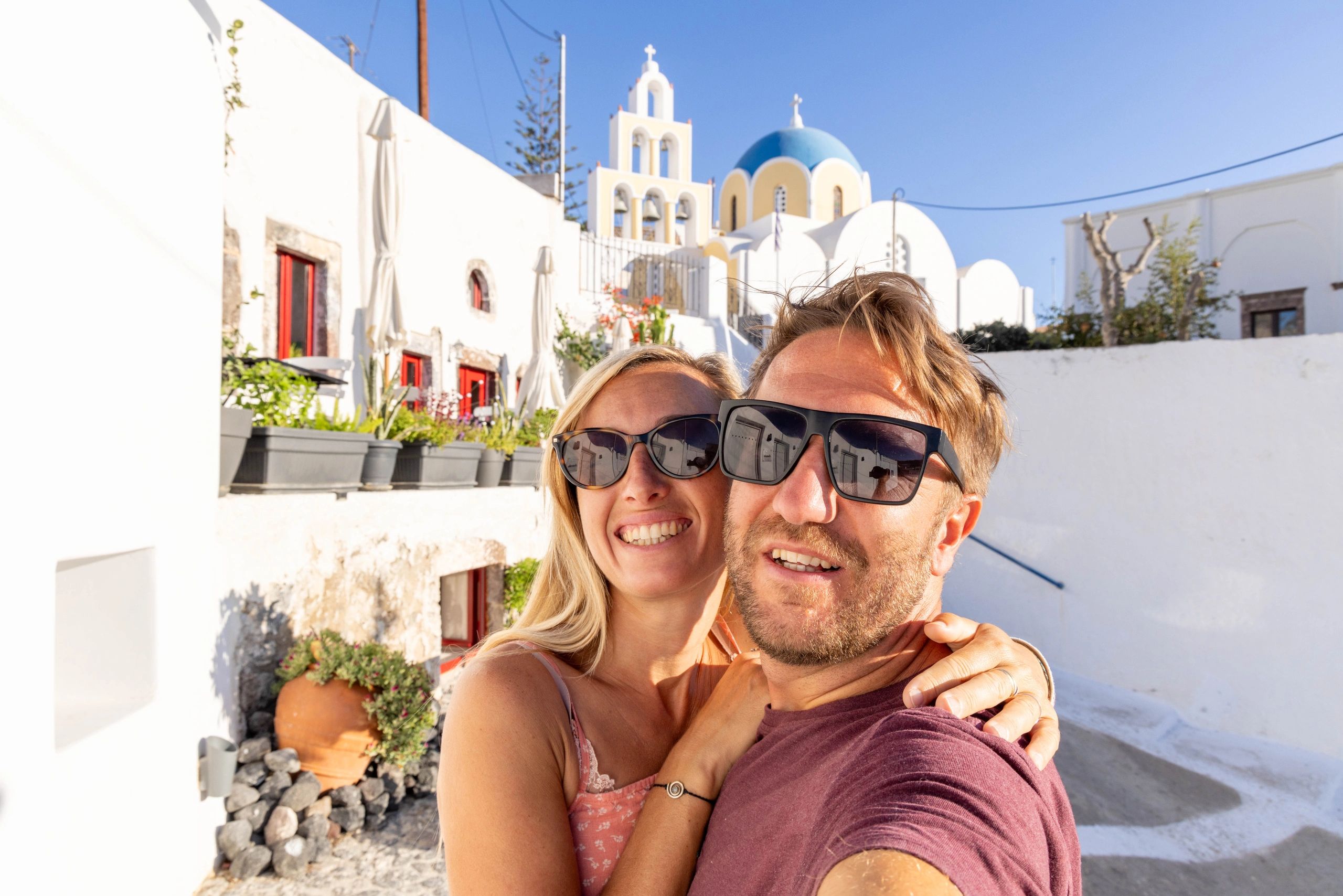

Every year, without fail, the clients who come back most enthusiastic — the ones who call us in October to start planning their return — are the ones who went in September.
It is not a coincidence.
September in Greece is a particular kind of magic. The summer crowds have thinned. The light has softened from the fierce white of August to something warmer and more golden. The sea, having absorbed months of sunshine, is at its warmest. And the pace of life — always the thing our clients love most about Greece — has settled into something that feels genuinely, unhurriedly Mediterranean.
Here is why we think September might be the best month to visit.
The sea is at its warmest
This surprises many people. The Mediterranean does not reach its peak temperature in July or August — it reaches it in September, when the water has had the entire summer to absorb heat. Sea temperatures around the Greek islands in September typically sit between 24°C and 27°C, which is warm enough to swim for hours without discomfort.
For our clients — many of whom tell us that swimming is the thing they love most about Greece — this matters enormously. There is a particular pleasure in slipping into warm, clear water at six in the evening, when the light is golden and the beach is almost empty. September gives you that almost every day.
The crowds have gone
The transformation between August and September in Greece is remarkable. The queues at Santorini's cable car disappear. The lanes of Oia become walkable again. The beaches — even the famous ones — have space. The tavernas have tables.
This is not just a matter of comfort, though it is certainly that. It is also a matter of experience. Greece is at its most itself when it is not performing for tourists. In September, the islands return to their natural rhythm. The locals are more relaxed. The service is more personal. The sense of having found somewhere real — rather than a theme park version of Greece — is much stronger.
The pace is better
August in Greece is intense. The heat is fierce, the days are long, and the pressure to see and do everything can be exhausting. September is different. The heat is still there — temperatures typically sit between 25°C and 30°C across most of the islands — but it is gentler, more comfortable, more conducive to the kind of holiday that actually restores you.
You can walk in the middle of the day without suffering. You can visit archaeological sites without feeling you are being cooked alive. You can take a long lunch — a proper Greek lunch, with wine, that stretches into the afternoon — without feeling guilty about the things you are not doing.
This is, in our experience, exactly what our clients want. Not a holiday that exhausts them with activity, but one that genuinely slows them down.
Long lunches are back
Speaking of long lunches: September is when the Greek taverna experience is at its best. The summer rush is over. The kitchen is not overwhelmed. The owner has time to come and sit with you, to tell you what is good today, to bring you something you did not order because he thinks you will like it.
Greek food in September also benefits from the season. The tomatoes are extraordinary — sun-ripened, sweet, nothing like what you find at home. The aubergines, the courgettes, the peppers: all at their peak. The fish is excellent. And the wine — particularly on islands like Santorini, Paros and Crete — is being made from grapes that are just reaching their perfect ripeness.
It is harvest season
September is grape harvest season across Greece, and it is one of the most atmospheric times to visit wine-producing islands. On Santorini, the harvest of the Assyrtiko grape — grown in the island's distinctive basket-trained vines — happens in late August and early September. On Crete, the harvest of Vidiano, Kotsifali and Mandilari grapes fills the mountain villages with activity.
Many of our clients who visit in September find themselves invited to participate in harvests, to visit wineries during production, to taste wines that are not yet bottled. It is the kind of experience that is impossible to plan and impossible to forget.
The olive harvest begins slightly later — October and November — but in September you can already see the nets being laid beneath the trees, and the anticipation of the harvest gives the island landscapes a particular energy.
Sightseeing is comfortable
Greece has some of the world's great archaeological sites, and in August they can be genuinely punishing. The Acropolis in Athens at noon in August, with temperatures above 35°C and thousands of other visitors, is an endurance test as much as a cultural experience.
In September, it is transformed. The temperature is manageable. The crowds are smaller. You can stand at the Parthenon and actually think about what you are looking at, rather than simply surviving it.
The same is true across the country. Knossos on Crete. Lindos on Rhodes. Ancient Thira on Santorini. The Palace of the Grand Masters in Rhodes Old Town. All of these are better — significantly better — in September than in the height of summer.
The light is extraordinary
Photographers know this, but it is worth saying for everyone: the light in Greece in September is extraordinary. The harsh, bleaching light of July and August gives way to something warmer and more golden — the light that makes the whitewashed walls glow, that turns the sea from blue to turquoise to silver in the space of an hour, that makes every photograph look like it was taken by a professional.
The sunsets in September are longer and more dramatic than in summer. The evenings are warm enough to sit outside until midnight, but cool enough to be comfortable. The mornings are clear and fresh.
It can be better value
We want to be careful here, because the best Greek holidays are never cheap, and September is not dramatically less expensive than August. But there is a difference. Hotel rates typically drop by 15–25% after the first week of September. Flights are generally less expensive. Restaurants are less likely to be fully booked.
For our clients who are flexible on dates, September often represents the best combination of value and experience. You get the same Greece — the same sea, the same food, the same beauty — for less, and with more of it to yourself.
Who September is perfect for
In our experience, September suits certain kinds of travellers particularly well:
Those who have been to Greece before and want to experience it at a different pace. If you went in August and loved it but found it overwhelming, September will feel like a revelation.
Those who prioritise swimming above all else. The warm sea in September is one of life's great pleasures.
Food and wine lovers. The harvest season, the relaxed tavernas, the peak-season produce: September is when Greek food is at its best.
Those who want to sightsee comfortably. If the Acropolis, Knossos or Lindos are on your list, September is the month to go.
Our older, more experienced clients — many of whom have been travelling for decades and know that the best experiences rarely happen in the middle of the crowd.
A final thought
We have been sending clients to Greece for 25 years, and we have never had a September complaint. Not one. The clients who go in September come back glowing, and they almost always book again for the following year.
If you are considering Greece and your dates are flexible, our advice is simple: go in September. You will not regret it.
Talk to us about planning your September holiday in Greece — we would love to help you find the right island, the right pace, and the right experience for you.

Written by
The Greeko Team
Greeko has been crafting bespoke Greek holidays for over 25 years. Every article is written from genuine first-hand knowledge of the islands, the culture, and the experiences that make Greece extraordinary.